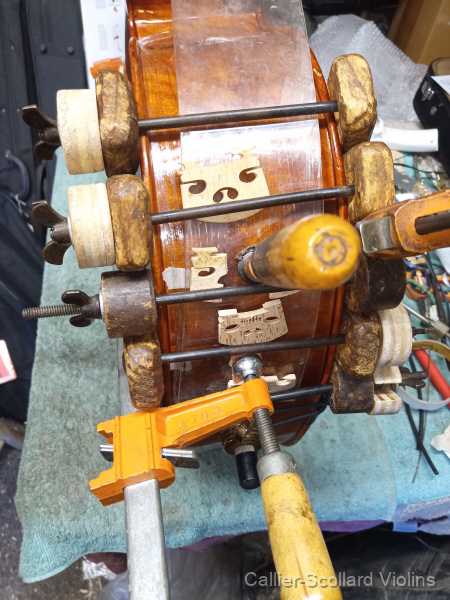
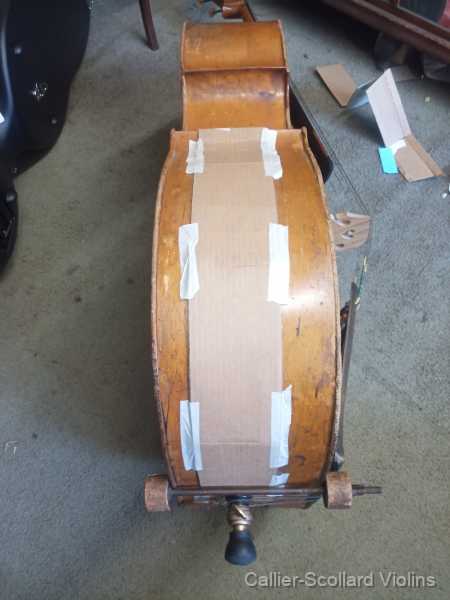
This student cello had a rib crack extending from the C-bout to the end block, and the rib had shifted slightly out of shape. Since the instrument did not justify removing the top, the repair began by opening the back seam and carefully clamping the rib back into proper alignment using wedges and bar clamps. Once the crack was closed and stable, internal cleats were installed using magnets and a line-guided clamping system to reinforce the joint without taking the top off the instrument.
Rib Crack Alignment and Cleat Installation Steps- Open the back seam: Carefully release the back seam to allow controlled movement and easier alignment of the rib crack.
- Perform a dry clamp test: Do a quick trial clamping to confirm the rib can be brought back into proper alignment before applying glue.
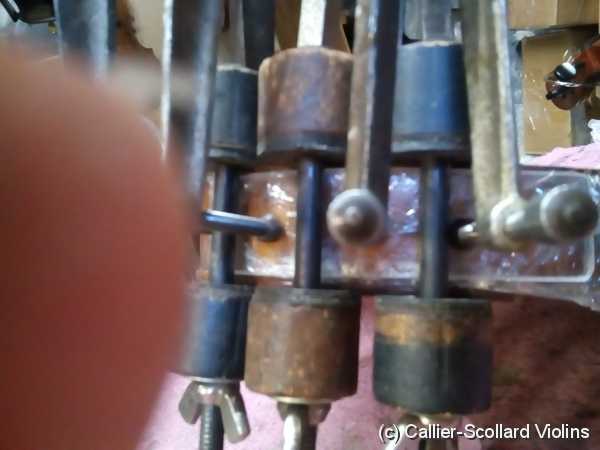
- Begin alignment at the C-bout: Starting near the C-bout, gradually align the crack while applying clamps along the length of the rib.
- Use wedges and bar clamps: A combination of wedges and bar clamps is used to correct the distortion and hold the rib in proper shape and alignment.
- Secure the instrument overnight: Strap the cello safely to the bench so it cannot move or fall over while the repair dries.
- Locate the crack for cleating: After removing the clamps, place a pair of magnets at the ends of the crack. Using a mirror and light makes it easy to see the exact position and angle of the crack.
- Plan the cleat positions: Two cleats were selected for reinforcement, and small pin holes were drilled to guide their placement.
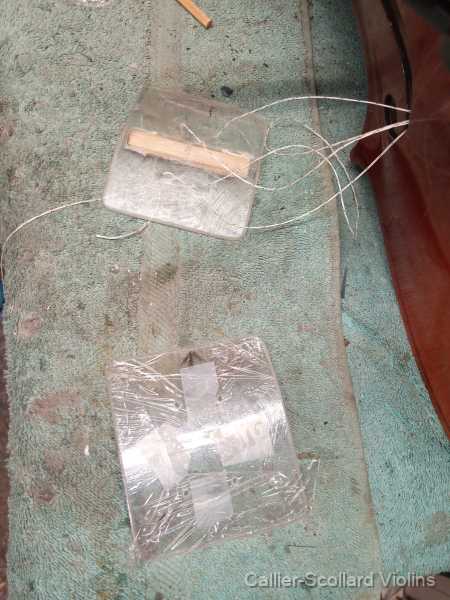
- Prepare the cleat holder: A small plastic holder slightly smaller than the cleat is made. A hole is drilled in the center, with a notch on the edge and slots on the top and bottom to guide the line.
- Thread the cleat assembly: Feed braided trolling line through the cleat, then through the plastic holder, routing it through the center hole, slots, and notch so the line stays centered. Tie a single knot to secure the alignment.
- Prepare the cleat: Soak the cleat and drill a hole through its center.
- Position the cleat: Apply a small amount of petroleum jelly to the back of the cleat, leaving a clean spot for a drop of CA glue.
- Hold the cleat with magnets: Use magnets to position the cleat against the rib until the CA glue sets.
- Apply wood glue: After removing the magnets, coat the cleat with wood glue for the permanent bond.
- Control glue flow: Lightly warm the glue with a heat gun to skin the surface so it does not run.
- Pull the cleat into position: Feed the cleat through the f-hole and pull the line tight.
- Tension the clamp line: Feed the line through a small hole in a clamp and wind the clamp until the line is very tight, pulling the cleat firmly against the rib.
- Release the clamping line: The next day, gently pull on both ends of the line until it loosens.
- Remove the holder: Pull the plastic clamping block out through the f-hole.
- Fill the guide holes: Fill the very small pin holes with tiny wooden pins.
- Trim and color the pins: After the glue dries, trim the pins flush and touch up the color.
- Seal the crack: Apply a light clear seal over the repaired crack.
- Final polish: Lightly polish the area to complete the repair.
 IMG 20260223 174150 571 IMG 20260223 174150 571 | IMG 20260224 101455 792 | IMG 20260224 101708 632 | IMG 20260303 164548 985 | IMG 20260303 180020 167 | IMG 20260304 103420 026 | IMG 20260305 123252 428 | IMG 20260310 112126 714 | IMG 20260312 114221 939 |
The rib crack aligned very well during clamping, and after removing the bar clamps I allowed the instrument to remain secured for several additional days to ensure the joint set firmly and remained stable. Because of the length of the crack, the best solution was to install two cleats using a line-guided clamping method. If the crack had been in a more accessible location, I likely could have positioned the cleats using magnets alone and avoided drilling the two small guide holes. I first used a similar technique about 30 years ago when repairing bass rib cracks, but at that time I used metal wire to pull the cleats into position. The wire worked, but it was difficult to feed through the crack and the f-hole and was awkward to handle. Using braided trolling line makes the process much easier. The line feeds smoothly through the rib and can be pulled very tight without breaking. The line is used once and discarded, while the small plastic clamping block can be reused for future repairs.
Here is another example of repairing a cello rib crack without removing the top. By clamping the rib against a mold, the crack could be held in proper alignment while controlled pressure was applied to close the joint. It’s a simple but effective approach that restores stability while avoiding more invasive disassembly of the instrument. IMG 20230814 165119 364 |
|